Official-channel export — HACCP · US FDA · China GACCTwo factories in Cu Chi & Phan Thiet — 100 tonnes a monthBulk orders & corporate gifting — business@greenchips.vnOfficial-channel export — HACCP · US FDA · China GACCTwo factories in Cu Chi & Phan Thiet — 100 tonnes a monthBulk orders & corporate gifting — business@greenchips.vn
How to dry durian at home: three methods and what each really gives you
Dehydrator, air fryer or freeze dryer: how each works, whether you get chewy or crisp durian, and why, based on US university extension guidance.
People who search "how to dry durian" usually want to keep its flavour for longer than a few days. There are three ways to do it at home: heat drying in a food dehydrator or an oven, drying in an air fryer, and a home freeze dryer. The three methods give three very different products. This article explains how each one works, what it produces and why, drawing on guidance from US university extension services and published research on durian aroma.
First, durian is a hard fruit to dry. According to the USDA FoodData Central database, 100 g of durian pulp contains about 147 kcal, 5.3 g of fat and 27.1 g of carbohydrate, far more fat and sugar than most fruit. Utah State University Extension's home freeze-drying guide lists high-fat and high-sugar foods as difficult: fat does not freeze the way water does, which slows drying, and sugar holds on to water, which lengthens the process. Durian has both.
Second, durian aroma escapes easily. In 2017 the research group of Martin Steinhaus (Leibniz Institute for Food Systems Biology at the Technical University of Munich) reported in the Journal of Agricultural and Food Chemistry that just two compounds, mixed at the ratio found in the fruit, recreate the characteristic durian smell: a fruity ester, ethyl (2S)-2-methylbutanoate, and a sulfur compound with a roasted-onion note, 1-(ethylsulfanyl)ethane-1-thiol. Both are small, volatile molecules that leave quickly under heat. That is why heat-dried durian usually smells much weaker than fresh durian.
Method one: food dehydrator or oven. The US National Center for Home Food Preservation (NCHFP, University of Georgia) recommends drying fruit at 140°F (60°C). In an oven, leave the door open 2 to 6 inches and place a fan by the gap so moisture can escape. Much higher temperatures cause case hardening: the surface dries hard and traps moisture inside. For durian, separate the pods, remove the seeds, cut even slices and lay them in a single layer without overlap. NCHFP suggests starting to check after about 8 hours; sugary fruit such as durian usually takes longer. A piece is done when it bends, is not sticky, and does not stick to itself when folded. The result is chewy dried durian: darker, intensely sweet, with a much milder smell than the fresh fruit. This method cannot make it crisp.
Method two: air fryer. This is the method most people search for. An air fryer is essentially a small convection oven with a strong fan. Many models have a low-temperature dehydrate setting; use that, at around 60°C, rather than the frying setting. At frying temperatures the sugar in durian caramelises and scorches on the outside before the inside has dried. The basket is small, so each batch is small and needs frequent turning and checking. The result is similar to method one: chewy, darker pieces with a roasted aroma. Tasty in a different way, but not crispy dried durian.
Method three: home freeze dryer. This is the only home method that gives light, crisp durian that keeps its yellow colour. According to USU Extension, the machine runs in three stages: deep freezing, a vacuum stage in which ice sublimates straight into vapour, and gentle warming to draw out the remaining water. A typical batch takes 20 to 40 hours, longer for sugary foods; fresh pineapple, for example, takes 48 to 52 hours. USU advises slices about ¼ to ½ inch thick, pre-frozen and spread in a single layer with space between pieces. Durian is done when it is crisp and evenly dry with no cold or soft spots. The drawbacks: home machines start at around US$2,000, the vacuum pump runs at 62 to 67 dB (close to a vacuum cleaner), electricity use is high, and oil pumps need regular oil changes.
Storage after drying. USU Extension points out that drying does not kill bacteria; it only makes them dormant, and they become active again if moisture returns. NCHFP advises letting dried fruit cool for 30 to 60 minutes before packing, because fruit packed warm sweats inside the bag and can grow mould. Crisp freeze-dried durian absorbs moisture very quickly and goes soft if left in open air. Use a foil-laminated bag or a truly airtight jar with a desiccant or oxygen absorber, because the fat in durian turns rancid on contact with air. Home-made chewy durian is best kept in the fridge and eaten within a short time.
A note on eating. A 2009 study in Food Chemistry (Maninang, Lizada and Gemma) found that durian extract inhibited up to about 70% of the activity of aldehyde dehydrogenase (ALDH), the enzyme that helps the body break down a by-product of alcohol. The test used a yeast enzyme, not humans, but the authors suggest it may explain why some people feel unwell after eating durian with alcohol. Caution is sensible, including with dried durian.
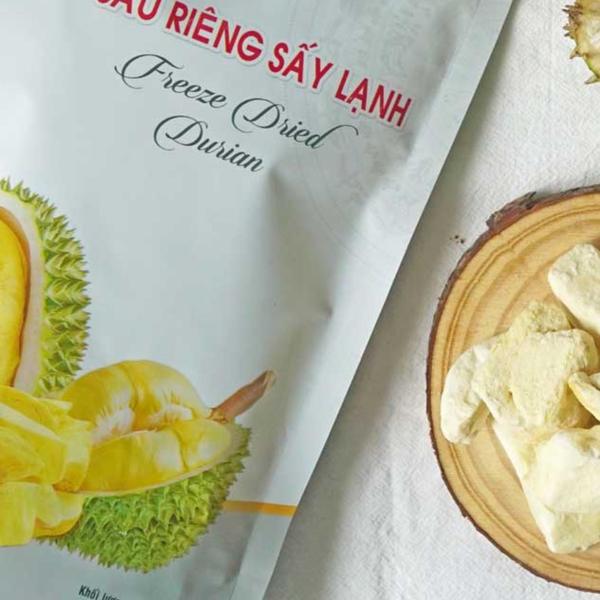
When to buy instead of making it. For chewy dried durian to eat within the week, a home dehydrator or air fryer is enough. For crisp pieces that keep their colour, store for months or work as a gift, you need freeze-drying: a machine costing thousands of dollars and close to two days of running time per batch. Green Chips freeze-dried durian is made by freeze-drying. The only ingredient is 100% durian, with no added sugar and no preservatives. It is packed in a PET/AL/PE foil-laminated pouch with a shelf life of 12 months from production. See Freeze-dried Durian on greenchips.vn, or read Freeze-dried durian: what it is and how to choose a good bag. Importers can contact business@greenchips.vn.
Sources: USDA FoodData Central (nutrient profile of raw durian) · National Center for Home Food Preservation, University of Georgia (fruit drying guidance) · Utah State University Extension ("Can I Freeze Dry That?" and "Buying a Home Freeze-Dryer") · Li, Schieberle and Steinhaus, Journal of Agricultural and Food Chemistry, 2017 (key durian odorants) · Maninang, Lizada and Gemma, Food Chemistry 117(2), 2009 (durian and the ALDH enzyme).